Why Your Stretching Feels Worse in the First Cool Weeks
Quick Answer: You have not lost flexibility — you have lost tissue temperature. Muscle and connective tissue are measurably more extensible when warm, and the same body stretched at 18C reaches noticeably less far than at 26C. Add a longer warm-up and the range returns within the same session. Stretching cold is also where most stretching injuries happen.
Every September, forward folds get shorter. Here is the mechanism, and what to change.

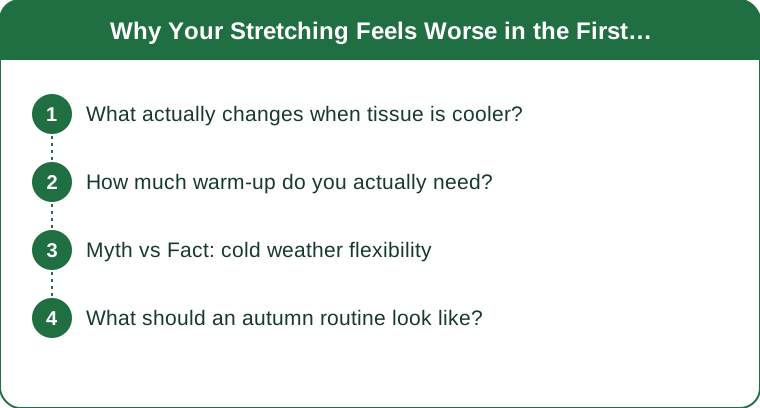
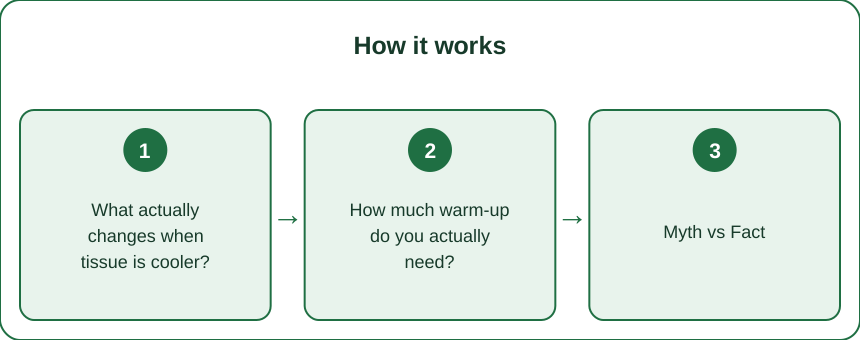
What actually changes when tissue is cooler?
Collagen behaves differently with temperature. Connective tissue — which is what limits most end-range positions — becomes more compliant as it warms. The effect is significant: tissue extensibility increases measurably over the working range between about 35C and 40C internal muscle temperature.
Cooler tissue is stiffer and more brittle. Not damaged, just less willing to deform. The same stretch that produced a comfortable pull in August produces a sharper, more protective sensation in September.
Your nervous system also gets more protective. The stretch reflex — the reflexive contraction that limits how far a muscle will lengthen — is more readily triggered in cold tissue. Much of what you feel as tightness is neural rather than mechanical.
Ambient temperature affects deep tissue slowly. A cool room does not immediately cool your hamstrings, but sitting in one for an hour before stretching genuinely does, and most people stretch after sitting still.
The result: identical body, identical technique, visibly less range.
How much warm-up do you actually need?
Five to ten minutes of general movement raises muscle temperature enough to matter. Walking, easy cycling, or a few rounds of dynamic movement. The goal is a light sweat, not fatigue.
Dynamic before static, always, and especially in autumn. Leg swings, controlled lunges, arm circles. Dynamic movement raises temperature and reduces reflex sensitivity simultaneously, which is exactly what cold tissue needs.
A hot shower is a legitimate warm-up for a home mobility session. Not as effective as movement, but genuinely better than nothing, and it makes the difference for early-morning stretching.
The room matters. Stretching in an 18C room in autumn produces meaningfully less range than the same routine in a 22C room. If your mobility work happens at home, heating the room ten minutes beforehand is a real intervention.
Stretch after training, not before it, if you want range. Post-session tissue is at its warmest and most compliant, and end-range work is both safer and more productive there.

Myth vs Fact: cold weather flexibility
Myth: You lose flexibility over the winter. Fact: You lose access to it. Actual tissue length changes take weeks of consistent work in either direction. What changes in September is temperature and warm-up habits.
Myth: Stretching harder compensates for being cold. Fact: It is how cold-weather stretching injuries happen. Force into a protective reflex and the tissue that gives is usually not the one you were targeting.
Myth: Static stretching before exercise prevents injury. Fact: The evidence does not support this, and prolonged static stretching immediately before power activities temporarily reduces force output. Dynamic warm-ups are the better pre-session choice.
Myth: You need to hold a stretch for two minutes to change anything. Fact: 30-60 seconds, repeated several times a week over months, produces the adaptations. Longer single holds add discomfort more than they add range.
Myth: Flexibility and mobility are the same thing. Fact: Flexibility is passive range; mobility is range you can control under your own strength. Mobility is the more useful quality and it responds to loaded end-range work, not just to stretching.
What should an autumn routine look like?
Move the session later in the day. Body temperature peaks in the late afternoon and early evening, and so does passive range for most people. A 6pm mobility session outperforms a 7am one considerably in October.
Ten minutes of movement first, non-negotiable. This is the change that recovers most of the lost range immediately.
Reduce the intensity of the stretch, not the frequency. Aim for a 4-5 out of 10 sensation rather than a 7-8. Consistency produces the adaptation; intensity mostly produces reluctance to do it again.
Add loaded end-range work twice a week. Slow eccentric movements through a full range — a deep controlled split squat, a Romanian deadlift with a long lowering phase — build usable range in a way passive stretching does not.
Track one measurement monthly. Fingertips to floor, or the distance from your knee to the wall in an ankle test. Sensation is a poor gauge in autumn precisely because temperature affects it so much, and a monthly measurement taken warm tells you what is really happening.
Sharp pain, tingling, or pain that persists after a session is not a stretching sensation and warrants an assessment. This is general information, not medical advice.
TL;DR:
- Cooler tissue is stiffer and more reflexively protective — you lost temperature, not flexibility.
- Ten minutes of dynamic movement first recovers most of the lost range in the same session.
- Stretch after training rather than before, and prefer later in the day when body temperature peaks.
- Aim for a moderate stretch sensation held 30-60 seconds, several times a week, over months.
- Add loaded end-range work twice weekly for mobility you can actually use.
September does not undo a summer of work. It just removes the free warm-up that summer was providing.
Keep Reading
This article is for general informational and styling purposes only. Fit, sizing, and product availability may vary.