What Stretching Actually Does If You Have Hypermobile Joints (It's Not What You'd Guess)
Quick Answer: For hypermobile joints, the priority shifts from increasing range of motion to building stability and control within the range you already have — since the joint already moves further than typical, more passive stretching can increase injury risk rather than reduce it. Strength-focused, controlled-range work matters more here than for the average person’s flexibility routine.
Most flexibility advice assumes the goal is more range of motion, but for someone with hypermobile joints, more range is rarely the problem — control within an already-generous range is.

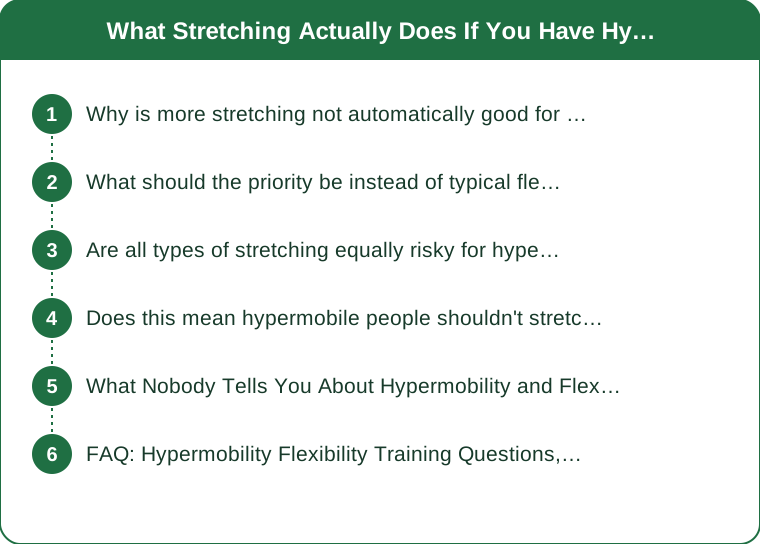
Why is more stretching not automatically good for hypermobile people?
Hypermobile joints already exceed typical range of motion, often due to more elastic connective tissue, and adding more passive stretching on top of that can push joints toward positions where the surrounding muscles and ligaments provide less protective support — the risk shifts from tightness to instability.
What should the priority be instead of typical flexibility goals?
Building strength and neuromuscular control through the joint’s existing range is generally the more supported focus — this means controlled, strength-based movement through a full range rather than passive stretching to extend that range further.
Are all types of stretching equally risky for hypermobile joints?
No — dynamic, controlled stretching within a normal range is generally lower risk than static stretching held at end-range, since end-range holds are where hypermobile joints are most likely to be pushed past a stable position without adequate muscular support.

Does this mean hypermobile people shouldn’t stretch at all?
Not at all — it means the type and intent shift. Gentle, controlled mobility work paired with strengthening is generally recommended over aggressive end-range static stretching, which is where caution specifically applies.
What Nobody Tells You About Hypermobility and Flexibility Training
A lot of hypermobile people are praised for being “naturally flexible” in ways that actually mask instability, since visually impressive range of motion (like touching palms flat to the floor easily) can look like a strength, when the underlying joint control is what actually needs the training attention.
Joint hypermobility syndrome (a diagnosable condition, distinct from simply being flexible) carries a higher injury risk profile that benefits from a physical therapist’s specific guidance rather than generic flexibility routines found online.
Proprioception (joint position sense) training is often more valuable than stretching itself for hypermobile individuals, since the core issue is often knowing where the joint is in space and controlling it there, not needing more range.
FAQ: Hypermobility Flexibility Training Questions, Answered
How do I know if I’m hypermobile versus just naturally flexible?
A common screening tool is the Beighton score, which a doctor or physical therapist can assess — it looks at specific joint ranges (thumb to forearm, elbow and knee hyperextension, among others) rather than general flexibility feel.
Is strength training safe for hypermobile joints?
Generally yes, and often specifically recommended, since building strength around a hypermobile joint is one of the more supported ways to add stability without reducing range.
Should someone with hypermobility avoid yoga or similar flexibility-focused activities?
Not necessarily, but modifying end-range static holds and adding more strength-focused elements within those practices is commonly recommended. This is general information, not medical advice — a physical therapist familiar with hypermobility can give more tailored guidance.
TL;DR:
- Hypermobile joints already exceed typical range, so the flexibility-training priority shifts to control, not more range
- Passive static stretching at end-range carries more risk for hypermobile joints than for typical ones
- Strength and proprioception training generally matter more here than traditional stretching
- A physical therapist familiar with hypermobility can give guidance tailored beyond general advice
Being naturally bendy was never the whole story — building control within that range is where the real work is.
Keep Reading
This article is for general informational and styling purposes only. Fit, sizing, and product availability may vary.