How Many Days a Week Should You Actually Stretch? The Real Frequency Answer
Quick Answer: 3-4 sessions per week of 10-15 minutes produces measurable flexibility gains within 4-6 weeks for most people — daily stretching isn’t required and can even slow progress if it prevents adequate recovery between sessions.
You’ve assumed more stretching equals faster results, so you’ve either committed to daily sessions you can’t sustain or given up entirely because daily felt impossible. The actual research-backed frequency is more forgiving than either extreme.

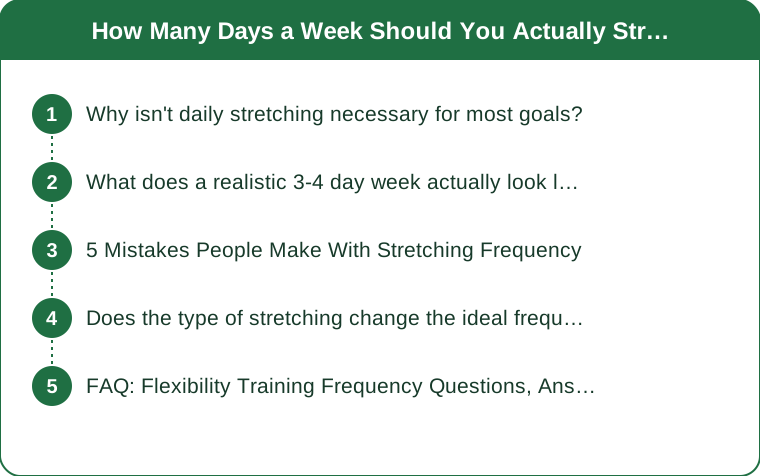
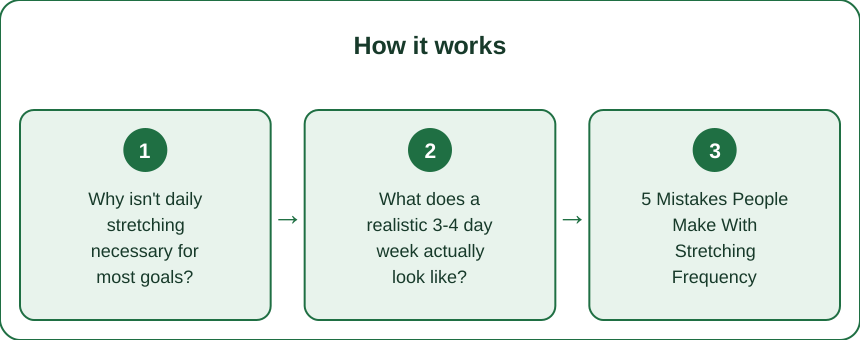
Why isn’t daily stretching necessary for most goals?
Flexibility gains come from tissue adapting to repeated stretch stimulus over time, not from constant stimulation. Connective tissue needs roughly 48 hours to respond to a stretching session — stacking sessions daily without that gap doesn’t meaningfully speed adaptation for most people.
The exception is active rehab for an injury or a specific short-term mobility goal (like preparing for a split), where daily supervised work under a professional’s guidance can make sense.
What does a realistic 3-4 day week actually look like?
Pick non-consecutive days — Monday, Wednesday, Friday, plus one weekend session works well for most schedules. Each session: 10-15 minutes targeting 3-4 major muscle groups, holding each stretch 30-60 seconds.
Consistency across weeks matters more than any single session’s length — four 10-minute sessions weekly for two months will outperform one 60-minute session done occasionally.

5 Mistakes People Make With Stretching Frequency
1. Going all-in for a week, then quitting. Flexibility gains reverse without maintenance — sporadic intense weeks don’t stick.
2. Stretching cold with no warm-up. Static stretching cold tissue is less effective and slightly more injury-prone than after light movement.
3. Skipping the same muscle group every time. Rotating focus areas evenly across the week produces more balanced results than always defaulting to hamstrings.
4. Confusing soreness with progress. Mild discomfort during a stretch is normal; sharp pain the next day means you overstretched, not that it “worked harder.”
5. Never reassessing. Retest your range of motion every few weeks — plateaus mean it’s time to adjust hold times or add PNF techniques, not just repeat the same routine.
Does the type of stretching change the ideal frequency?
Static stretching (holding a position) works well at 3-4x/week. Dynamic stretching (moving through range) can be done daily since it doubles as a warm-up and carries lower tissue-stress risk. PNF stretching (contract-relax techniques) is more intense and often best limited to 2-3x/week with rest days between.
Mixing types across the week — dynamic daily, static 3-4x, occasional PNF — tends to produce the most well-rounded results.
FAQ: Flexibility Training Frequency Questions, Answered
Can I see results with just 2 days a week?
Some improvement, yes, but progress is noticeably slower — 3-4 days is the sweet spot most studies point to for meaningful gains within a couple months.
Is it bad to stretch the same muscle group two days in a row?
Not harmful, but less efficient — spacing at least a day between intense sessions on the same muscle group allows better adaptation.
How long until I notice real flexibility improvement?
Most people notice measurable range-of-motion change by week 4-6 of consistent 3-4x/week work — earlier for some joints, later for tighter areas like hips.
TL;DR:
- 3-4 non-consecutive sessions weekly, 10-15 minutes each, beats daily inconsistent effort
- Tissue needs about 48 hours to adapt — daily static stretching isn’t necessary for most goals
- Dynamic stretching can be daily; static and PNF work better with rest days
- Reassess range of motion every few weeks to catch plateaus
Keep Reading
This article is for general informational and styling purposes only. Fit, sizing, and product availability may vary.