Does It Matter What Time of Day You Stretch? Here's What Actually Changes
Quick Answer: Muscles are naturally stiffer in the morning due to lower body temperature and reduced fluid in spinal discs, making evening stretching generally easier and deeper — but morning stretching still has real benefits for mobility and alertness. Consistency matters more than picking the ‘perfect’ time.
That stiff, tight feeling during a 7am stretch versus the looser range you get at 7pm isn’t inconsistency in your flexibility — it’s a real physiological difference tied to time of day.

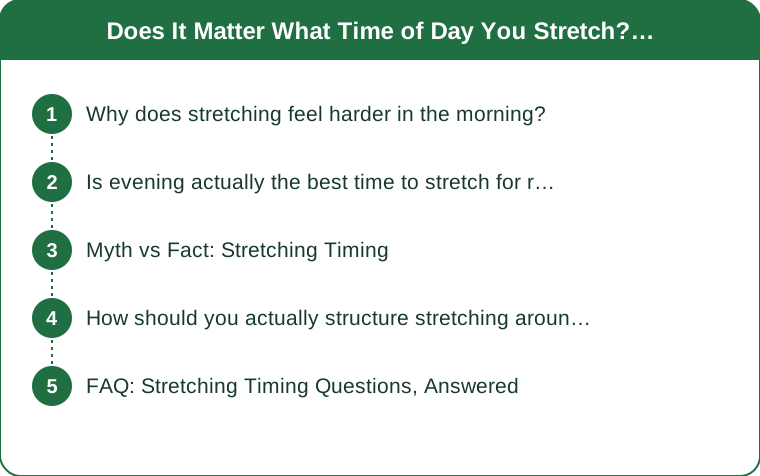
Why does stretching feel harder in the morning?
Body temperature is at its daily low point in the early morning, and cooler muscle tissue is measurably less pliable than warmed tissue — a well-documented effect, not just perception.
Spinal discs also absorb fluid overnight while lying flat, making the lower back and hamstrings feel tighter specifically in the first hour or two after waking — another real, physical reason morning flexibility work feels different.
Is evening actually the best time to stretch for range of motion gains?
For raw range of motion in a single session, yes — body temperature peaks in the late afternoon to early evening, giving muscles their most pliable state of the day and typically the deepest safe stretch.
That said, ‘best for one session’ and ‘best for building a lasting habit’ aren’t the same thing — the time you’ll actually do consistently beats the theoretically optimal time you’ll skip half the week.

Myth vs Fact: Stretching Timing
Myth: Morning stretching is pointless because muscles are cold. Fact: Morning stretching, done gently and with a brief warm-up first, is genuinely valuable for mobility and reducing stiffness through the day — it’s just a different kind of session than a deep evening stretch.
Myth: You need to hold stretches longer in the morning to get the same benefit. Fact: Forcing longer holds on cold tissue increases strain risk rather than compensating for stiffness — a brief warm-up first is the better fix than pushing duration.
Myth: Stretching before bed disrupts sleep. Fact: Gentle evening stretching, especially with slow breathing, is more commonly associated with better sleep onset than worse, for most people.
How should you actually structure stretching around time of day?
Morning: 5 minutes of light dynamic movement (leg swings, arm circles) rather than deep static holds on cold muscle — this supports mobility without strain risk.
Evening: the better window for deeper static stretches and range-of-motion work, since body temperature and tissue pliability are at their daily peak.
If you only have one slot available, that slot is still worth using — an imperfect-timing stretch habit beats a perfectly-timed one you don’t actually do.
FAQ: Stretching Timing Questions, Answered
Should you warm up before morning stretching?
Yes — even 2-3 minutes of light movement (marching in place, arm circles) before static stretches reduces strain risk on cold morning muscle.
Is it bad to stretch right before a workout?
Static stretching immediately pre-workout can slightly reduce power output for that session — dynamic stretching is generally the better pre-workout choice, saving static holds for after.
Does time of day affect flexibility progress over months?
Less than consistency does — someone stretching moderately every evening will out-progress someone chasing the ‘perfect’ window inconsistently.
TL;DR:
- Morning stiffness is real — lower body temperature and disc fluid absorption both contribute
- Late afternoon to early evening is the physiological sweet spot for deep static stretching
- Morning sessions should stay light and dynamic rather than deep static holds
- Consistency at any reasonable time beats chasing the perfect window
Pick the time you’ll actually keep — that beats the theoretically optimal one every time.
Keep Reading
This article is for general informational and styling purposes only. Fit, sizing, and product availability may vary.