Why You Feel Less Flexible in September Than You Did in July
Quick Answer: Range of motion is temperature-dependent, and both ambient temperature and tissue temperature drop in autumn. Cooler muscle and connective tissue are stiffer and less compliant, which reduces measured flexibility without any actual loss of tissue length. The response is a longer warm-up before stretching, not more aggressive stretching - pushing into a cold range is where injuries come from.
The practical rule: never stretch as the first thing you do. Ten minutes of general movement first changes range of motion more than the stretching itself does.
This is general information rather than medical advice.
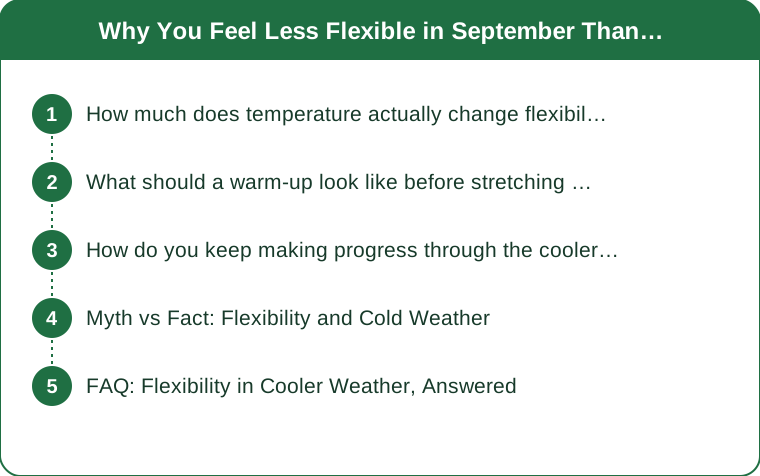
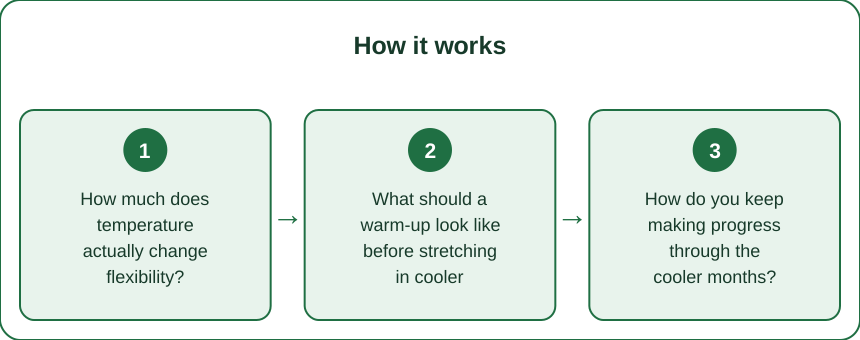
How much does temperature actually change flexibility?
Enough to explain the entire seasonal difference people notice.
The mechanism. Muscle and connective tissue are viscoelastic - their mechanical behaviour depends on temperature. Warmer tissue deforms more readily under a given force and returns more efficiently. Cooler tissue is stiffer and resists lengthening.
What the research shows. Studies on warm-up and range of motion consistently find that raising tissue temperature increases measurable flexibility, and that active warm-up produces greater gains than passive heating. The effect is not marginal - it is a substantial proportion of the range people gain in a session.
The two temperatures that matter:
- Ambient temperature, which affects skin and superficial tissue quickly
- Deep muscle temperature, which changes slowly and is raised effectively only by activity
Which explains a common experience. A warm room does not fully solve it. Sitting in a heated room does not raise deep muscle temperature much, which is why stretching after arriving indoors from the cold still feels restricted.
The other seasonal factors that stack on top:
- Reduced daily movement as daylight shortens. Less incidental movement means tissue spends more time in shortened positions
- More sitting, which particularly affects hip flexors and hamstrings
- Different footwear, which changes calf and ankle range as heel drop changes
- Poorer sleep during a schedule transition, which affects perceived stiffness independently
The important reassurance. You have not lost flexibility. Tissue length does not change over a few weeks of cooler weather. What changed is the temperature at which you are measuring it, and it comes straight back with an adequate warm-up.
What should a warm-up look like before stretching in cooler weather?
Longer, active, and general before specific - and it is not optional now.
The structure:
- 5 to 10 minutes of general activity first. Walking, cycling, easy rowing, or simply moving around. The goal is raising core and muscle temperature, and the marker is light sweating
- Then dynamic movement through range - leg swings, arm circles, controlled lunges, cat-cow. 5 minutes
- Then static stretching if that is the goal, at which point the tissue will respond as it did in July
Why active beats passive. A hot shower or a heat pack raises skin temperature quickly and deep muscle temperature very little. Activity raises deep temperature through metabolic heat production, which is what actually matters.
How much longer in autumn. Roughly double the summer warm-up. If 5 minutes was enough in July, allow 10 now. In a cold room or first thing in the morning, allow more.
The morning problem specifically. Everyone is stiffest on waking - spinal discs are hydrated after a night lying down, and tissue temperature is at its daily low. Stretching hard first thing is both least effective and highest risk.
- Move for 10 minutes before stretching in the morning, without exception
- Or move the stretching session to the afternoon or evening, when body temperature peaks. Range of motion is measurably greater in the late afternoon than in the early morning
What to avoid:
- Stretching cold to see where you are. This is how people find their limit and exceed it in the same movement
- Long static holds before training, which temporarily reduce force production. Dynamic before, static after
- Comparing today’s range against a summer session and pushing to close the gap, which is the specific behaviour that causes strains

How do you keep making progress through the cooler months?
Consistency and load, rather than intensity - and one approach has considerably better evidence than plain stretching.
What actually produces lasting range of motion change. Not passive stretching alone. Loaded stretching and end-range strength work produce more durable improvements, because they change the nervous system’s tolerance to lengthened positions as well as the tissue itself.
Practical applications:
- Eccentric work through full range - slow lowering phases in squats, Romanian deadlifts, calf raises off a step
- End-range isometrics. Get to the end of your comfortable range and hold a gentle contraction for 10 to 20 seconds. This builds strength where you are weakest, which is what limits range for many people
- Full range of motion strength training generally, which improves flexibility about as effectively as stretching does in several trials
Frequency over duration:
- 5 to 10 minutes most days beats 45 minutes once a week by a wide margin
- Static holds of 30 seconds, 2 to 3 times per area, is the range with the best support
- Total weekly time per muscle group matters more than session structure
Where to focus as the season changes:
- Hip flexors and hamstrings, which shorten with increased sitting
- Calves and ankles, which are affected by the footwear change and which limit squat depth and gait
- Thoracic spine, which stiffens with more indoor desk time
- Chest and front shoulders, for the same reason
What to expect. Meaningful range of motion change takes 6 to 8 weeks of consistent work, and the gains are largely neural in the early weeks rather than structural. Progress will look slower in cold months because each session starts from a stiffer baseline, which is a measurement issue rather than a progress issue.
When stiffness is not just stiffness. Persistent one-sided restriction, stiffness with pain, joint stiffness that is worse in the morning and lasts over an hour, or a sudden loss of range - those warrant assessment rather than more stretching.
Myth vs Fact: Flexibility and Cold Weather
Myth: You lose flexibility over the winter. Fact: Tissue length does not change over weeks. Measured range drops because tissue is cooler and you move less, and it returns immediately with an adequate warm-up.
Myth: A hot shower is a good warm-up before stretching. Fact: It raises skin temperature and does very little for deep muscle temperature. Active movement is what raises the temperature that matters.
Myth: Stretching prevents injury. Fact: Static stretching before activity has not shown reliable injury prevention, and it temporarily reduces force production. Dynamic warm-up before, static stretching after, is the pattern with better support.
Myth: You should stretch first thing in the morning. Fact: Morning is when tissue temperature is lowest and spinal discs are most hydrated - the least effective and highest-risk time. Move for ten minutes first, or stretch in the afternoon.
Myth: More aggressive stretching produces faster progress. Fact: Range of motion improvements are largely about nervous-system tolerance in the early weeks. Loaded end-range work outperforms aggressive passive stretching, and it is considerably safer.
Myth: Strength training makes you less flexible. Fact: Full range of motion strength training improves flexibility about as effectively as stretching in several trials, and the improvements tend to be more durable.
FAQ: Flexibility in Cooler Weather, Answered
Why am I less flexible than I was in summer?
Muscle and connective tissue are viscoelastic - they are stiffer when cooler. Both ambient and deep tissue temperature drop in autumn, which reduces measured range without any change in tissue length.
How long should I warm up before stretching now?
Roughly double your summer warm-up. Ten minutes of general activity until you are lightly sweating, then dynamic movement, then static stretching if that is the goal.
Does a hot shower count as a warm-up?
Not really. It raises skin temperature and barely affects deep muscle temperature, which is what determines how tissue responds to stretching.
When is the best time of day to stretch?
Late afternoon or early evening, when body temperature peaks and range of motion is measurably greater. Morning is the stiffest and highest-risk time.
How often should I stretch to improve?
Five to ten minutes most days beats a long weekly session. Expect meaningful change over 6 to 8 weeks, largely neural at first.
Is stretching or strength training better for flexibility?
Full range of motion strength training performs about as well as stretching in several trials, and end-range loaded work tends to produce more durable gains.
TL;DR:
- Cooler tissue is stiffer, so measured flexibility drops in autumn without any actual loss of length
- Double your warm-up: 10 minutes of activity until lightly sweating, then dynamic, then static
- A hot shower barely raises deep muscle temperature - only movement does
- Late afternoon is when range of motion peaks; morning is the stiffest and riskiest time
- Loaded end-range work and full-range strength training beat aggressive passive stretching for durable gains
You did not lose anything over the last six weeks. You are measuring at a lower temperature.
Keep Reading
This article is for general informational and styling purposes only. Fit, sizing, and product availability may vary.