Why Stretching Feels So Much Easier on a Hot Day - and What That Actually Means
Quick Answer: Higher tissue temperature reduces the passive stiffness of muscle and connective tissue and, more importantly, raises your stretch tolerance - the point at which your nervous system decides the stretch is too much. Warm-weather flexibility is largely a temporary effect that disappears when you cool down, which is why it does not represent a lasting gain. Real range improvement comes from consistent loaded work at end range, not from stretching when it happens to feel good.
All summer, the forward fold got easier. Then a cool morning arrived and you were back where you started in June, which feels like losing something. You did not lose anything. You were borrowing it, and the loan was always short term.
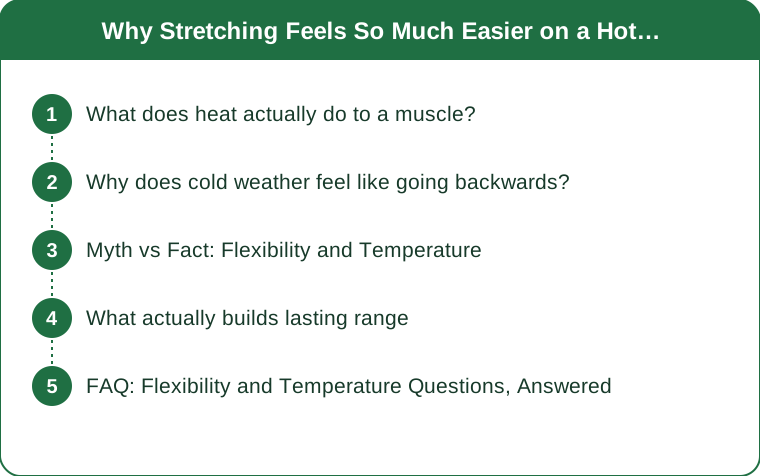
What does heat actually do to a muscle?
Two separate things, and only one of them is the one people assume.
It reduces passive stiffness, modestly. Warmer connective tissue is somewhat more compliant - collagen and the surrounding matrix deform more readily at higher temperature. This is real, and it is why warming up before stretching is genuinely sensible.
But the effect is smaller than the sensation suggests. The measurable change in mechanical stiffness from a normal warm-up is modest. It does not explain an extra several centimetres in a forward fold.
The larger effect is on stretch tolerance. Most acute flexibility change - from warming up, from repeated stretches within a session, from a hot day - comes from a change in how much stretch sensation you are willing to accept, not from the tissue becoming longer. Your nervous system has a protective limit, and that limit moves.
Temperature affects that limit in several ways. Warmth reduces the discomfort of a given amount of stretch, blood flow to the tissue is higher, and there is a general relaxation effect that reduces resting muscle tone.
Which means the summer flexibility was real in the moment and not durable. You genuinely could reach further. The reaching further was permitted rather than earned, and the permission was withdrawn when the temperature dropped.
And this is not a criticism of stretching. It is an argument for understanding what you are measuring, because measuring range on a hot day and again on a cold one produces a comparison that tells you about the weather.
Why does cold weather feel like going backwards?
Because several things stack in the same direction at once.
Tissue temperature is lower at rest. In cooler ambient conditions, resting muscle temperature - particularly in the extremities and superficial muscles - is measurably lower, which increases passive stiffness.
Resting muscle tone tends to be higher. Cold produces a mild increase in muscle tone as part of the body’s heat conservation response. Slightly higher tone means slightly less range before the stretch sensation arrives.
Stretch tolerance drops. The same amount of stretch feels more uncomfortable when cold, so the protective limit arrives sooner.
Activity patterns change. People move less in cooler months, spend more time sitting indoors, and walk less because daylight is shorter. Reduced daily movement genuinely does reduce available range over weeks, and this is the one component that is not temporary.
And the comparison itself is unfair. You are comparing a warm afternoon in August, probably after a day of moving around, to a cool morning in October before you have done anything. Those two measurements were never comparable, and neither of them is your “real” flexibility.
The honest conclusion: some of the autumn decline is temperature and disappears within ten minutes of warming up. Some of it is genuinely reduced activity and will persist until the activity returns. Distinguishing them takes one experiment - warm up thoroughly for fifteen minutes and re-test.

Myth vs Fact: Flexibility and Temperature
Myth: Stretching when warm makes you more flexible long term. Fact: Stretching when warm lets you access more range during the session, which is useful. Long-term range improvement comes from consistent exposure to end range over weeks, ideally with load, and the temperature at which you do it is a minor variable.
Myth: Cold muscles tear more easily when stretched. Fact: The evidence on cold and injury risk is less clear-cut than the folklore suggests. What is well supported is that a warm-up improves performance and that ballistic stretching of cold tissue is unwise. Gentle stretching when cool is not dangerous; it is just less productive and less comfortable.
Myth: You lose flexibility over winter. Fact: You lose some, and the majority of it is reduced activity rather than temperature. People who maintain their movement volume through autumn and winter lose very little, which points clearly at the actual cause.
Myth: Static stretching before exercise reduces performance. Fact: Long holds - over 60 seconds per muscle - can transiently reduce force and power output. Short holds of under 30 seconds within a broader dynamic warm-up have minimal effect and are fine. The blanket “never stretch before exercise” advice overstates a real but narrow finding.
Myth: If it hurts, it is working. Fact: Pain is the protective limit signalling, and pushing through it does not produce faster adaptation. A moderate sensation of stretch, held and breathed through, is the productive zone. Sharp pain is a stop signal at any temperature.
What actually builds lasting range
Four things, none of which depend on the weather.
1. Consistency over intensity. Range improves from frequent exposure to end range - five to seven days a week of a few minutes beats one long session weekly. The adaptation is partly neural, as stretch tolerance increases durably with repeated exposure, and partly structural over longer timescales.
2. Loaded end-range work, which is the biggest lever. Strength training through a full range of motion produces flexibility gains comparable to stretching in a number of studies, and it produces strength at those ranges as well. A deep squat, a full-range Romanian deadlift, a deep split squat, an overhead press with full lockout - these build usable range rather than passive range.
3. Long holds, if you are doing static work. 30 to 60 seconds per position, two to four rounds. Shorter holds do very little for lasting change, and this is where most people’s stretching routines fall down - fifteen seconds is a warm-up, not a stimulus.
4. Warming up first, for comfort and access. Five to ten minutes of light movement before stretching lets you work at genuine end range rather than at your cold protective limit. This is where the temperature effect is legitimately useful - not as a source of gains, but as access to the range where gains happen.
And the specific autumn strategy: the drop you notice in October is mostly access, not capacity. Warm up longer - ten minutes rather than three - do your mobility work indoors after activity rather than before, and protect your daily walking volume as daylight shrinks. Those three changes address the whole seasonal decline.
How long until it holds? Meaningful, durable range change takes six to twelve weeks of consistent work. Anything faster than that is stretch tolerance moving, which is real but reverses when you stop.
Sharp pain, joint pain rather than muscle sensation, or numbness during stretching are reasons to stop and get assessed. This is general information, not medical advice.
FAQ: Flexibility and Temperature Questions, Answered
Why am I more flexible in hot weather?
Mostly because warmth raises your stretch tolerance - the point at which your nervous system decides the stretch is too much - rather than because the tissue is meaningfully longer. Reduced passive stiffness contributes, but the effect is smaller than the sensation suggests, and both reverse when you cool down.
Do you lose flexibility in winter?
Some, and most of it is reduced daily activity rather than temperature. People who maintain their movement volume through the colder months lose very little range, which points at activity as the real variable rather than the weather.
How long should I hold a stretch?
30 to 60 seconds per position for lasting change, repeated two to four times. Fifteen-second holds are effectively a warm-up rather than a training stimulus, which is why many routines produce no durable improvement despite being done consistently.
What is the fastest way to actually improve flexibility?
Strength training through a full range of motion - deep squats, full-range hinges, overhead work with complete lockout. In several studies it produces gains comparable to stretching while also building strength at those ranges, which makes the range usable rather than only passive.
TL;DR:
- Most acute flexibility change is stretch tolerance moving, not tissue lengthening.
- Heat raises that tolerance temporarily; cold lowers it, and both reverse.
- Autumn decline is partly temperature (reverses in ten minutes) and partly reduced activity (does not).
- Lasting range comes from frequent exposure, 30 to 60 second holds, and full-range strength work.
- Warm up ten minutes rather than three, and protect your daily walking as the light goes.
August did not make you flexible. August made you permitted, and October just changed the terms.
Keep Reading
This article is for general informational and styling purposes only. Fit, sizing, and product availability may vary.