Why Your Flexibility Changes Across Your Menstrual Cycle
Quick Answer: Joint laxity does shift across the cycle, with the largest increases generally reported around ovulation, when oestrogen peaks. The practical effect is real but modest, and it varies enormously between individuals. What matters more than chasing the flexible window is knowing that more range does not mean more stability - the ovulatory window is also when ACL injury rates are highest in the research. Use the flexible phase for range work, use the rest of the cycle for strengthening through that range, and stop measuring progress against a single good day.
If you have ever wondered why a stretch you owned last Tuesday is gone this Tuesday despite doing everything the same, this is a large part of the answer - and it is not a training failure.

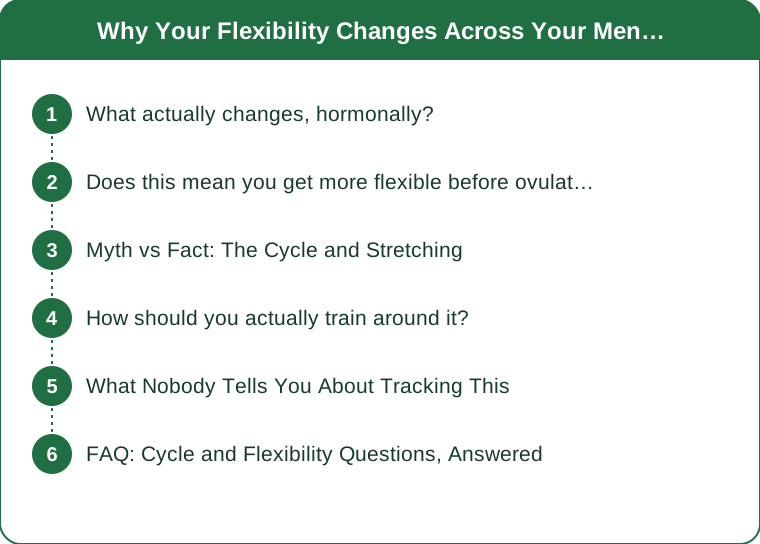
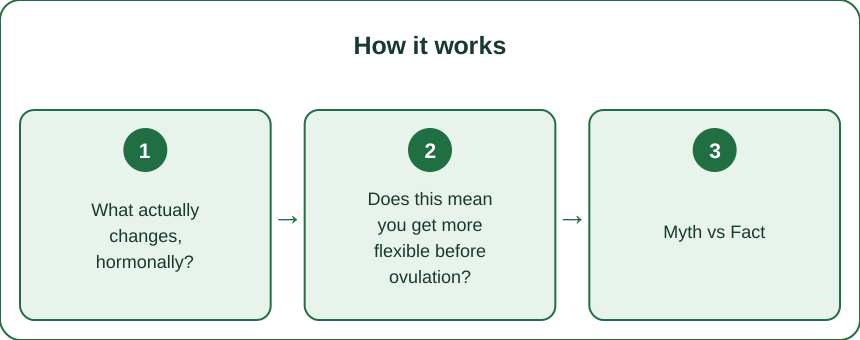
What actually changes, hormonally?
Three hormones move across the cycle and two of them affect connective tissue directly.
Oestrogen rises through the follicular phase and peaks just before ovulation. It affects collagen synthesis and appears to reduce the stiffness of tendons and ligaments. Higher oestrogen is broadly associated with greater joint laxity.
Relaxin is best known from pregnancy but is present across the cycle, and it rises modestly in the luteal phase. Its role outside pregnancy is less well established than the popular version suggests, and the evidence for a large cycle effect from relaxin alone is weaker than most articles imply.
Progesterone rises after ovulation and its interaction with collagen is more complex, with some evidence it partially offsets oestrogen’s effect.
The honest summary: the research is genuinely mixed on magnitude. Multiple studies find measurable increases in joint laxity around ovulation; others find the effect small or inconsistent. What is clear is that individual variation is large - some women notice a substantial difference, others notice none at all, and both are normal.
Which is why the useful approach is tracking your own pattern rather than following a generic cycle template.
Does this mean you get more flexible before ovulation?
Often yes, and it is worth being precise about what kind of flexibility.
Passive range tends to increase. How far a joint can be moved by an external force - the range you find in a supported stretch, a partner stretch, or a deep passive hold - shows the clearest cycle effect.
Active range changes less. How far you can move a joint under your own muscular control depends more on strength and motor control, and those are less affected by the cycle.
This distinction matters because passive range without matching active control is where injury risk lives. A joint that can be pushed further than you can control it is a joint relying on ligaments rather than muscles.
What people actually report: the mid-cycle week often feels loose and open, and the days before a period often feel stiff and heavy. The stiffness in the late luteal phase is frequently more about fluid retention and general fatigue than about connective tissue, which is why it responds well to a longer warm-up in a way that genuine tissue restriction does not.
A useful framing: your baseline flexibility has not changed. Your access to it has.
Myth vs Fact: The Cycle and Stretching
Myth: You should only stretch during the flexible phase. Fact: Flexibility adaptations come from consistent loading over months. Stretching only one week in four gives you a quarter of the stimulus. Stretch throughout; adjust the intensity, not the frequency.
Myth: Relaxin makes you significantly more injury-prone every month. Fact: The relaxin story is largely borrowed from pregnancy physiology. The cycle-related injury signal in the research clusters around the ovulatory and late follicular phase, which is more consistent with the oestrogen peak than with relaxin.
Myth: Losing range before your period means you are going backwards. Fact: It is a temporary access issue, usually with fluid retention and fatigue involved. It returns.
Myth: You should push harder in the flexible window to make gains faster. Fact: This is the most common and most costly error. The window where you can reach furthest is also the window where your joints are least protected. Pushing into new end range there is how people acquire injuries they blame on nothing in particular.
Myth: Everyone experiences this the same way. Fact: Variation between women is large enough that generic cycle-phase templates are near useless. Your own two-month log is worth more.

How should you actually train around it?
Adjust the emphasis, not the schedule. Four phases, in broad terms.
Menstrual phase. Energy is often lower, but flexibility itself is generally reasonable. Good for gentle mobility work and longer, easier holds. Do not force it; do not skip it.
Follicular phase. Energy climbing, connective tissue getting more compliant. The best window for genuine range work and for hard training generally. This is where most people feel strongest and stretch best simultaneously.
Ovulation. Maximum laxity, and the phase with the highest reported ACL injury rate in the literature. Keep stretching to your normal range rather than pushing into new territory, and pay attention to landing mechanics and change-of-direction work. This is a warning, not a reason to stop training.
Luteal phase. Often stiffer and heavier feeling, higher core temperature, more perceived effort. Warm up longer - ten minutes rather than five - and focus on strengthening through the range you already have rather than trying to extend it.
Across all of it, the highest-value work is the same: loaded stretching and end-range strength. Building control into the range you can already reach is what makes flexibility durable, and it is unaffected by which week it is.
What Nobody Tells You About Tracking This
The most useful thing you can do takes two minutes a week and almost nobody does it.
Pick one repeatable measurement and take it weekly, at the same time of day, after the same warm-up. A seated forward fold measured with a tape from fingertips to a fixed point. A weight-bearing lunge test distance. Anything you can measure the same way every time.
Log it alongside your cycle day. Two months gives you a pattern. Three gives you confidence in it.
Why this matters more than any generic advice: the individual variation is the headline finding in this area. You may have a pronounced mid-cycle swing, or almost none. Generic phase-based training plans are guessing about you specifically, and two months of your own data replaces all of them.
The second benefit is psychological, and it is bigger than it sounds. Once you can see that your forward fold moves by a predictable amount across the month, a stiff Tuesday stops feeling like evidence that you have lost your progress. That interpretation - the sense of going backwards - is what makes people abandon flexibility work, far more often than the stiffness itself.
One caveat: hormonal contraception changes this picture, generally flattening the cycle variation. If you are on a combined pill, you may find very little pattern at all, and that is expected rather than a measurement failure.
FAQ: Cycle and Flexibility Questions, Answered
Should I avoid deep stretching around ovulation entirely?
No. Stretch normally, but do not chase a new personal best in end range that week. Work in the range you already own.
Why do I feel so stiff the day before my period?
A combination of fluid retention, higher core temperature, and fatigue rather than a genuine tissue change. A longer warm-up usually recovers most of it.
Does this affect strength training too?
Some research suggests slightly better strength adaptations in the follicular phase, but the effect sizes are small and the evidence is not strong enough to restructure a whole programme around. Consistency matters far more.
What if my cycle is irregular?
Track symptoms rather than dates - energy, stiffness, and mood are usable markers. And an irregular cycle is worth mentioning to a doctor, since it can point at things worth knowing about.
This is general information, not medical advice.
TL;DR:
- Joint laxity does shift across the cycle, with the clearest increase around ovulation - but individual variation is huge.
- Passive range changes more than active range, which is exactly why the flexible window is also the riskier one.
- Stretch every phase; adjust intensity rather than frequency.
- Use the follicular phase for range work, the luteal phase for strengthening what you have, and warm up longer when stiff.
- Two months of your own weekly measurement beats any generic cycle template.
The useful takeaway is not a schedule. It is that a stiff week is information rather than failure - and knowing that is what keeps people stretching long enough to actually get more flexible.
Keep Reading
This article is for general informational and styling purposes only. Fit, sizing, and product availability may vary.