Why Your Flexibility Drops After a Rest Day
Quick Answer: You are not less flexible after a rest day - you are less warm and less neurologically primed. Range of motion depends heavily on tissue temperature and on how recently your nervous system has practiced tolerating end range. A day without movement lowers both. Muscle length does not change in 24 hours, and 10 minutes of general movement usually restores the range you think you lost.
It is a genuinely confusing experience. Train five days, take Sunday off, and Monday’s forward fold is two inches shallower than Friday’s. Rest was supposed to help.

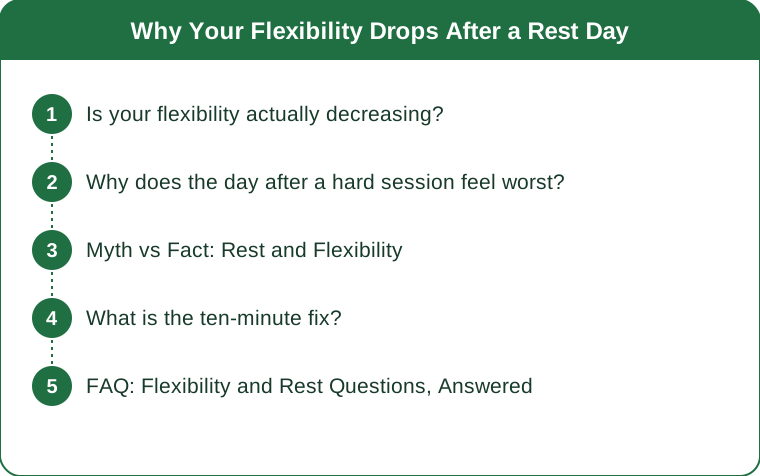
Is your flexibility actually decreasing?
Almost certainly not. Three separate things are being measured at once, and only one of them is true flexibility.
Tissue temperature changes range immediately. Warm muscle and connective tissue deform more easily than cold. A day of sitting means your tissue has been at resting temperature for 24 hours, and cold tissue simply moves less. This can account for several inches in a forward fold with no change to the tissue itself.
Your nervous system sets a limit, and it is adjustable. Range of motion is governed by a protective threshold - your brain permits the range it has recently seen and considers safe. Stretch regularly and the threshold moves outward. Skip a day and it retreats slightly, because the recent evidence is thinner.
Fluid distribution shifts. Time spent lying down or sitting redistributes fluid, and tissue that is slightly more swollen has slightly less give. This is why the same stretch is hardest first thing in the morning and easiest in early evening.
Actual detraining takes weeks. Meaningful loss of passive range takes on the order of three to four weeks of complete inactivity. One day is not close.
Why does the day after a hard session feel worst?
Because you are measuring soreness, not stiffness, and they feel identical from the inside.
Delayed onset soreness peaks at 24 to 48 hours. That is exactly when your rest day falls if you train hard on Saturday and rest Sunday. Sore muscle resists lengthening - the resistance is protective, and it resolves on its own.
Sore tissue also raises the neurological limit. Your body reduces available range around tissue it considers damaged. This is useful behavior that feels like a setback.
Eccentric work causes the most of it. Lowering phases - slow negatives, downhill running, deep lunges - produce more soreness and therefore more apparent stiffness than concentric-heavy work.
Which is why a light rest day beats a still one. Twenty minutes of walking or easy cycling raises tissue temperature, moves fluid, and reduces soreness measurably. A full day on the sofa does none of it, and you pay for it in Monday’s warm-up.

Myth vs Fact: Rest and Flexibility
Myth: Muscles shorten when you do not stretch them. Fact: Muscle does adapt in length over long timeframes, in both directions, but the timescale is weeks of consistent position - not one day off. What changes overnight is tolerance and temperature.
Myth: Morning stiffness means you slept badly. Fact: Everyone is stiffest in the morning. Fluid accumulates in tissue overnight, body temperature is at its lowest around waking, and you have not moved for hours. This is universal, not diagnostic.
Myth: You should stretch cold to build real flexibility. Fact: Stretching without a warm-up produces less range and more discomfort, which teaches your nervous system that end range is dangerous - the opposite of what you want. Five minutes of movement first is not cheating.
Myth: Static stretching before training makes you weaker, so it is useless. Fact: Long static holds immediately before heavy lifting can reduce peak force slightly, which is why they belong after training or in a separate session - not why they should be dropped. The research on flexibility gains from static stretching is solid.
Myth: If you lose it in a day, it was never real. Fact: You did not lose it. Warm up and measure again - the range is still there. What you lost was access to it, and access is restored by movement.
What is the ten-minute fix?
Raise temperature first, then take end range through a few controlled reps rather than one long hold.
Five minutes of general movement. Brisk walking, easy cycling, or a few rounds of bodyweight movement - enough to feel slightly warm. Do not stretch first. Temperature is the single biggest lever and it is the fastest to move.
Then two to three minutes of dynamic range work. Controlled leg swings, hip circles, cat-cow, thoracic rotations. Move into end range and back out, 8 to 10 times per position, rather than holding.
Finish with 30 to 60 second holds only where you want long-term change. Static holds build tolerance over weeks, and after-training or after-warm-up is the right slot for them.
Re-test the same movement. Use one repeatable test - a forward fold to a mark on the wall, or a lunge with your knee to a taped line - and compare warm to warm, never cold to warm. Most of the panic about lost flexibility is a measurement error.
And schedule one moving rest day per week rather than a still one. A 30-minute walk on the day off is enough to keep both temperature and tolerance from dropping, and it does not interfere with recovery in any meaningful way.
FAQ: Flexibility and Rest Questions, Answered
Should I stretch on rest days?
Light mobility work on rest days is beneficial and does not compromise recovery. Save heavy or aggressive stretching for days when you are already warm from training.
How long does it take to actually lose flexibility?
Measurable loss of passive range generally requires around three to four weeks without any stretching or full-range movement. Even then, regaining it is much faster than building it originally.
Why am I more flexible in the evening?
Core body temperature peaks in late afternoon to early evening, and you have been moving for hours. Evening sessions typically show the largest range of the day, which is worth knowing if you are testing progress.
Does age change this?
The warm-up requirement increases with age - tissue takes longer to reach working temperature, and the gap between cold range and warm range widens. The adaptation itself still works. Budget a longer warm-up rather than assuming less potential.
This is general information, not medical advice. Persistent stiffness in one specific joint, or stiffness with pain or swelling, is worth discussing with a physio or doctor.
TL;DR:
- You did not lose flexibility overnight - you lost temperature and neurological access, both of which return in minutes.
- Delayed soreness peaks 24 to 48 hours post-training, exactly when your rest day lands.
- Warm up before you test or stretch; five minutes of general movement is the biggest single lever.
- Real detraining takes three to four weeks, and a light moving rest day prevents most of the apparent loss.
The useful reframe is that flexibility on any given day is a reading, not a possession. It moves with the time of day, the temperature, how sore you are, and how recently you practiced. Comparing a cold Monday morning to a warm Friday evening tells you nothing except that the conditions were different - and once you always test warm, the graph starts going the direction you expected.
Keep Reading
This article is for general informational and styling purposes only. Fit, sizing, and product availability may vary.