Why Flexibility Gains Seem to Completely Disappear After Just One Week Off
Quick Answer: Most of what feels like lost flexibility after a week off is temporary — a reduction in the nervous system’s tolerance for stretch sensation, not an actual loss of tissue length — and the majority of it typically returns within just a few sessions of resuming, faster than it took to build originally.
A week off genuinely does reduce measured range of motion somewhat, but the sharp regression it feels like is usually more dramatic than the actual underlying change.

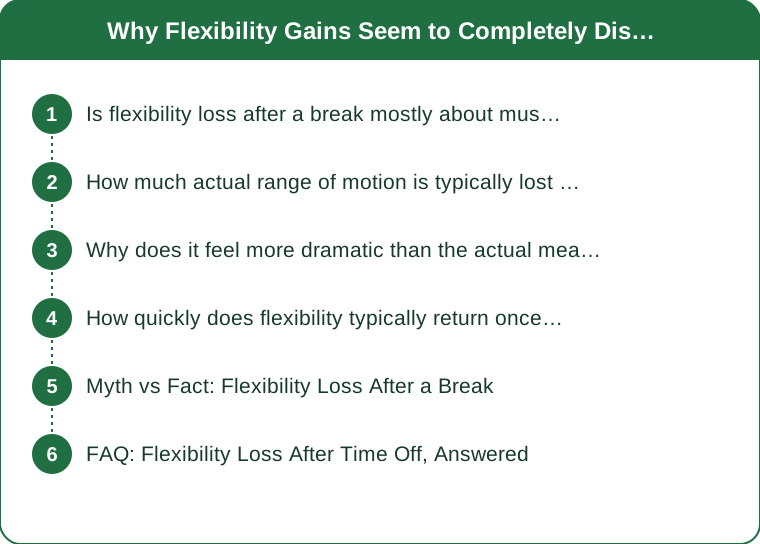
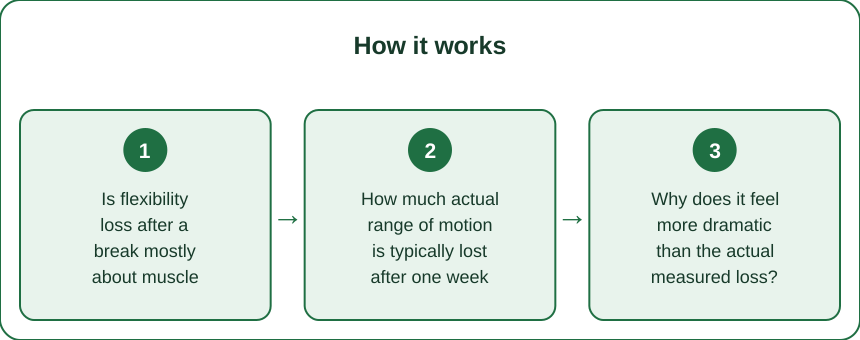
Is flexibility loss after a break mostly about muscle tissue or something else?
Mostly something else — stretch tolerance, which is largely a nervous system adaptation (how much stretch sensation your body allows before signaling to stop), regresses faster than actual tissue-level changes, meaning a lot of the felt “tightness” after a break is a nervous system recalibration rather than the muscle itself shortening in that short a time.
How much actual range of motion is typically lost after one week off?
Research on detraining effects generally shows modest measurable range-of-motion loss after roughly one week, often in the range of a few degrees rather than a dramatic full regression — the subjective feeling of having lost much more than that is common but doesn’t fully match the objective measurement.
Why does it feel more dramatic than the actual measured loss?
Because stretch tolerance regresses faster than tissue length does, the first session back can feel notably tighter and less comfortable even though true range of motion hasn’t dropped nearly as much — that discomfort gap is often mistaken for a bigger loss than actually occurred.

How quickly does flexibility typically return once stretching resumes?
For most people, the majority of a short break’s loss returns within the first 1-3 sessions back, considerably faster than the weeks or months it originally took to build that range — this is consistent with the loss being mostly a tolerance issue rather than a structural one.
Myth vs Fact: Flexibility Loss After a Break
Myth: A week off erases weeks of progress. Fact: measured range-of-motion loss after a week is typically modest, and most of it returns within the first few sessions back.
Myth: The tight feeling in the first session back means you’re starting over. Fact: that tightness mostly reflects reduced stretch tolerance, not actual tissue shortening, and it resolves faster than true flexibility building does.
Myth: Longer breaks and shorter breaks cause proportionally the same kind of loss. Fact: longer breaks (a month or more) do involve more genuine tissue-level change, so the recovery timeline for a month off is meaningfully longer than for a single week off.
FAQ: Flexibility Loss After Time Off, Answered
Does age affect how quickly flexibility is lost or regained after a break?
Some research suggests older adults may see somewhat faster regression and slightly slower regain, though the general pattern of tolerance-based loss recovering faster than true structural change still holds across ages.
Is it worth easing back in gently after a week off, or diving back into the previous routine?
Easing in gently for the first session or two is generally a reasonable, comfortable approach, though it’s not strictly necessary from an injury-risk standpoint for most people after just a week off.
Does a week off from stretching also affect strength or only flexibility?
A single week off has a much smaller measurable effect on strength than on stretch tolerance specifically, since strength detraining generally takes longer than a week to become measurable for most trained individuals.
TL;DR:
- Most felt flexibility loss after a week off is reduced stretch tolerance, not true tissue change
- Actual measured range-of-motion loss after one week is typically modest
- Stretch tolerance regresses faster than it feels, exaggerating how bad the loss seems
- Most of a short break’s loss returns within the first 1-3 sessions back
A week off didn’t erase the progress — it just temporarily lowered how much stretch felt tolerable, and that comes back fast.
Keep Reading
This article is for general informational and styling purposes only. Fit, sizing, and product availability may vary.