Why Your Left and Right Side Stretch Differently
Quick Answer: Almost everyone is more flexible on one side than the other, and small differences are normal - the result of handedness, habitual posture, sleeping position and old injuries. Differences worth addressing are large ones, ones that are getting worse, and ones accompanied by pain or a hard end-feel rather than a stretching sensation. The fix is not stretching the tight side more; it is stretching the tight side first and holding the loose side to its shorter range.
You fold forward and the right leg goes further than the left, the way it always does.
That is not a flaw you need to correct. Sometimes it is, and there are specific ways to tell.
This is general information, not medical advice.

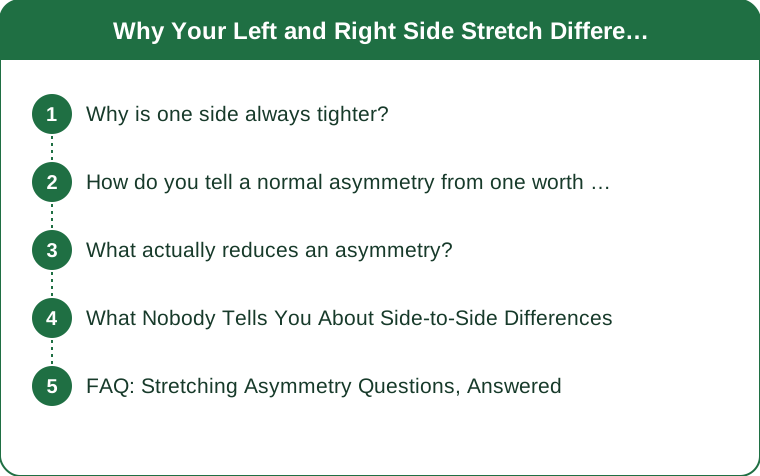
Why is one side always tighter?
Several reasons stack, and most of them are ordinary.
Handedness and habitual loading. Almost everyone uses one side preferentially - carrying, reaching, standing with weight on one leg, driving with one foot on a pedal. Sustained asymmetric use produces asymmetric tissue adaptation over years.
Sleeping position. If you consistently sleep on one side, that hip spends seven hours a night in a different position from the other. This is one of the more underrated contributors and it is worth checking against which side is tighter.
Old injuries, including ones you have forgotten. A sprained ankle from a decade ago can leave a persistent movement compensation, and the tissue adapts around it long after the injury itself is irrelevant.
Structural anatomy, which is the one you cannot change. Hip socket depth and orientation vary between individuals and between the two sides of the same person. Some range differences are bony rather than muscular, and no amount of stretching alters them.
Everyday posture at work. A desk setup that has you rotated slightly toward a monitor, or a phone always held to one ear, produces exactly this kind of pattern.
Which is why small asymmetries are so common that they are effectively the norm. The useful question is not whether you have one, but whether yours is in the range worth acting on.
How do you tell a normal asymmetry from one worth addressing?
Three questions, and the third is the important one.
1. How big is it? A modest difference - one side reaching slightly less far - is very common. A large, obvious difference where one side reaches substantially less is worth looking into, particularly if it affects how you move rather than just how you stretch.
2. Is it changing? A stable long-term difference is much less concerning than one that has appeared or grown over recent months. A new asymmetry has a cause, and the cause is worth finding.
3. What does the end of the range feel like? This is the most informative question and the one nobody asks.
- A stretching sensation in the muscle belly that eases as you hold is a normal soft-tissue limit
- A hard, abrupt stop with no stretch sensation suggests a bony or joint limit, and more stretching will not change it
- Pain, particularly sharp or radiating pain, is a stop signal rather than a stretch
- A pinching sensation at the front of the hip typically indicates joint compression rather than muscle tightness, and pushing into it is counterproductive
Additional flags worth acting on: asymmetry accompanied by numbness or tingling, asymmetry that appeared after a specific incident, and asymmetry that is causing pain during normal activity rather than only during stretching.
All of those are reasons to see a physiotherapist rather than to stretch harder, and the hard end-feel one in particular is commonly misdiagnosed by people as tightness that needs more work.

What actually reduces an asymmetry?
Stretch the tight side first and more, and hold the loose side back.
The counterintuitive part is the second half. Most people stretch both sides equally, which maintains the difference indefinitely - both improve, the gap stays.
A protocol that works:
- Start with the tight side. You have most attention and least fatigue at the beginning of a session
- Do an extra set on the tight side - two rounds to the loose side’s one
- Only take the loose side to the tight side’s range, not to its own end range. This is the part people skip and it is what actually closes the gap
- Finish with the tight side again
On what kind of stretching: static holds of around 30 seconds are effective for range, and strength work through the full range is more durable than stretching alone. Range gained without strength at the new length tends to be lost quickly.
Timeline: meaningful change in range takes weeks, not days. Four to six weeks of consistent work is the realistic window for a modest asymmetry, and larger ones take longer.
Also address the cause, not just the symptom:
- Check your sleeping side against your tight side
- Look at your desk setup for rotation
- Notice which leg you stand on and which shoulder carries the bag
Because if the daily pattern that created the asymmetry continues unchanged, stretching is a treadmill. Twenty-three hours of asymmetric habit versus ten minutes of stretching is not a fair contest.
What Nobody Tells You About Side-to-Side Differences
Five things that change the approach.
Some asymmetry is structural and permanent. Hip socket orientation varies between individuals and between sides, and where the limit is bony no amount of stretching moves it. The hard end-feel test is how you tell, and pushing into a bony limit causes irritation rather than progress.
The tighter side is often the stronger side. This surprises people. Habitual use builds both strength and stiffness, so the dominant side is frequently both more capable and less mobile. Stretching it without maintaining its strength is not obviously the right trade.
Your sleeping position is a bigger factor than your stretching routine. Seven hours a night in one position versus ten minutes of stretching is not a close comparison. Checking which side you sleep on against which side is tight is a genuinely useful two-second diagnostic.
Asymmetry that appeared suddenly is different from asymmetry you have always had. A long-standing difference is usually just how you are built and used. A new one within months has a cause worth identifying, and it is the version most worth a professional opinion.
Equal stretching maintains the gap forever. This is the practical point most people miss. If you stretch both sides the same amount, both improve and the difference persists indefinitely. Closing a gap requires deliberately unequal work, including holding the good side back - which feels wrong and is exactly what makes it work.
FAQ: Stretching Asymmetry Questions, Answered
Is it normal for one side to be tighter?
Yes, and it is close to universal. Handedness, sleeping position, habitual posture and old injuries all produce it. Small stable differences are unremarkable and usually not worth acting on.
How much difference is too much?
There is no precise threshold. What matters more is whether it is large enough to affect how you move, whether it is getting worse, and whether the end of the range feels like a stretch or like a hard stop.
Should I stretch the tight side more?
Yes, and also hold the loose side back to the tight side’s range. Stretching both equally maintains the gap indefinitely, which is why most people’s asymmetry never changes despite years of stretching.
What does a hard end-feel mean?
An abrupt stop with no stretching sensation suggests a bony or joint limit rather than a muscular one. More stretching will not change it and can irritate the joint. That one is worth a professional assessment.
Could my sleeping position be causing it?
Quite possibly, and it is worth checking - seven hours a night in one position is a much larger input than a stretching session. If your tight side matches the side you sleep on, that is a meaningful clue.
How long before I see a change?
Four to six weeks of consistent work for a modest difference, longer for a large one. Range gained without strength at the new length tends to be lost, so pair stretching with strength work through the full range.
TL;DR:
- Side-to-side differences are close to universal, caused by handedness, sleeping position, posture and old injuries
- Worth acting on: large differences, new or worsening ones, and anything with pain or a hard end-feel
- A hard abrupt stop with no stretch sensation is likely bony - more stretching will not move it
- Stretch the tight side first and twice; hold the loose side to the tight side’s range
- Equal stretching on both sides maintains the gap indefinitely
- Address the daily cause too - sleeping side, desk rotation, which shoulder carries the bag
- Expect four to six weeks, and pair range work with strength at the new length
The asymmetry is usually normal. What is not normal is expecting it to change while you treat both sides the same.
Keep Reading
This article is for general informational and styling purposes only. Fit, sizing, and product availability may vary.