Why You Are Noticeably More Flexible at 6pm Than at 7am
Quick Answer: Flexibility varies substantially across the day, typically peaking in the late afternoon or early evening. Three things drive it: core body temperature, which peaks around the same time and makes tissue more compliant; spinal disc fluid, which is highest overnight and compresses through the day making you slightly shorter but more mobile; and accumulated movement, which progressively reduces resting muscle tone. The morning-to-evening difference can be several inches on a forward fold.
It does not mean morning stretching is pointless. It means you should not compare the two.


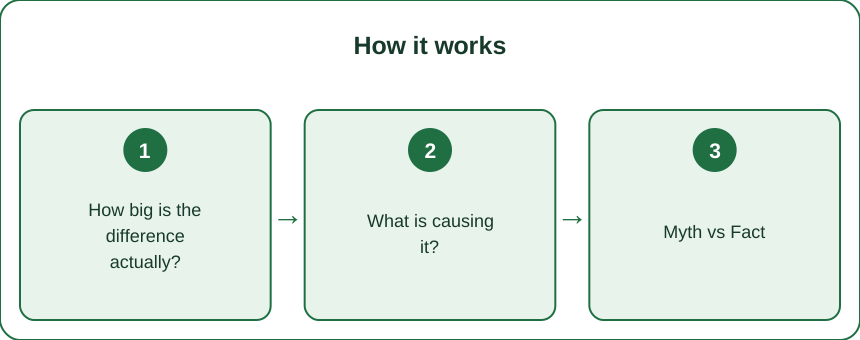
How big is the difference actually?
Larger than most people expect, and measurable on yourself in a week.
Studies on diurnal variation in flexibility consistently find meaningful differences across the day, with range of motion typically greatest in the late afternoon to early evening and lowest first thing in the morning. Reported differences in trunk flexion and hamstring range are frequently in the range of several centimetres.
You can verify it easily. Do a seated forward fold within ten minutes of waking, note where your fingers reach, and repeat at 6pm on the same day with no other stretching in between. The difference is usually obvious.
The practical consequence is that comparing your morning flexibility to your evening flexibility is meaningless, and a lot of people do exactly this and conclude they are getting worse. If you stretched in the evening for a month and then switched to mornings, your numbers will drop even though nothing about your tissue changed.
The rule that follows: measure at a consistent time of day, the way you would weigh yourself. Any progress tracking that mixes morning and evening measurements is measuring the clock rather than the tissue.
What is causing it?
Three mechanisms, running on different timescales.
Core body temperature. Body temperature follows a circadian rhythm, typically bottoming out in the early hours and peaking in the late afternoon to early evening - a swing of around one degree Celsius. Warmer muscle and connective tissue is more compliant; the viscous component of tissue resistance drops as temperature rises. This is the same reason a warm-up increases range of motion, operating on a 24-hour cycle instead of a 10-minute one.
Spinal disc hydration. Intervertebral discs absorb fluid overnight while you are horizontal and unloaded, and lose it gradually through the day under compression. Most people are measurably taller in the morning - commonly around half an inch to nearly an inch. Fully hydrated discs are under more internal pressure and the spine is stiffer in flexion, which is a large part of why a morning forward fold feels so much shorter.
This one has a safety implication: spinal loading in flexion is generally considered higher-risk in the first hour after waking, when disc pressure is at its highest. It is a reasonable argument for not doing loaded spinal flexion first thing.
Accumulated movement. Resting muscle tone decreases with activity through the day. By evening you have walked, moved, and sat and stood repeatedly, all of which reduces the neural component of stiffness. This is the mechanism most people intuitively expect, and it is genuinely the smallest of the three.
The three stack, which is why the difference is so noticeable.

Myth vs Fact: Time of Day and Stretching
Myth: Morning stretching is bad for you. Fact: Morning stretching is fine and is a good habit. What is worth being careful about is aggressive loaded spinal flexion in the first hour after waking, when discs are maximally hydrated. Gentle mobility work, joint circles, and light stretching are entirely appropriate and are how a lot of people best start the day.
Myth: Evening stretching produces better long-term gains because you can reach further. Fact: This is intuitive and not well supported. Long-term flexibility adaptation appears to depend on total stretching volume and consistency rather than the absolute range achieved in a given session. A morning session at 90 percent of your evening range, done daily, will almost certainly beat an evening session done twice a week.
Myth: If I am stiff in the morning, my flexibility is poor. Fact: Morning stiffness is universal and is largely a disc-hydration and temperature phenomenon. It says very little about your actual tissue extensibility. Judge yourself at a consistent time, and preferably after a warm-up.
Myth: You should always warm up before stretching, at any time of day. Fact: True for anything involving significant range or load. But the size of the required warm-up varies with the time of day - a morning session genuinely needs more of one than an evening session, because you are starting from a colder, stiffer baseline. Five minutes of easy movement in the morning is worth ten minutes of stretching.
How should this change what you do?
Four practical adjustments, in order of how much they matter.
Measure at a consistent time. If you are tracking flexibility - and you should be, since it changes slowly and is easy to misjudge - pick one time and stick to it. Evening measurements will look better; morning measurements are more consistent between days because they are less affected by what you happened to do that day.
Warm up more in the morning, and accept less range. A morning session should start with 5 to 10 minutes of easy movement rather than going straight into holds, and you should expect to reach less far. That is not a failure and it does not reduce the training effect.
Put the harder work in the afternoon if you have a choice. For anything genuinely at the edge of your range - a deep split, an advanced position - the late afternoon or early evening is when tissue is most compliant and the session will be most productive. This is also when strength and power peak, which is convenient if you are combining the two.
Avoid loaded spinal flexion first thing. Deadlifts, heavy rows, and deep loaded forward folds are better an hour or more into the day. If you train early, spend longer warming up and consider ordering the session so that spinal loading comes later in it.
One thing not to change: frequency. The single strongest predictor of flexibility improvement is how often you stretch, not when. A daily morning routine that fits your life beats an optimal evening routine that happens twice a week, and it is not close. This is general information, not medical advice.
FAQ: Daily Flexibility Variation Questions, Answered
Does this affect strength too?
Yes, in the same direction. Strength and power output typically peak in the late afternoon, tracking the same core temperature rhythm. The effect is smaller than the flexibility effect but it is measurable, and it is why personal bests are more often set in the afternoon than at 6am.
What about people who train very early by necessity?
They adapt to a degree - regular early training shifts some of the circadian pattern, and the performance gap narrows with consistent early exposure. It does not disappear entirely, but a habitual 6am trainer is not operating at the same disadvantage as someone doing it for the first time.
Is the morning-tall thing real?
Yes, and it is well documented. Most people lose around half an inch to nearly an inch of height through the day as spinal discs compress, and recover it overnight. Astronauts in microgravity gain considerably more, for the same reason, since there is no compressive load at all.
Should I stretch before bed?
It is a reasonable time - tissue is compliant and gentle stretching can support the wind-down before sleep. Keep it gentle rather than intense, since a hard stretching session is arousing rather than relaxing for some people. The evidence for stretching improving sleep specifically is modest, but it is a pleasant habit with no downside.
TL;DR:
- Flexibility peaks in the late afternoon or early evening, with morning-to-evening differences of several centimetres on a forward fold.
- Three causes: core temperature peaking in the afternoon, spinal discs being fully hydrated and stiff in the morning, and accumulated movement reducing muscle tone.
- Most people are half an inch to nearly an inch taller in the morning, which is a large part of why a morning fold feels short.
- Measure at a consistent time of day, or you are tracking the clock rather than your tissue.
- Warm up longer in the morning, put edge-of-range work in the afternoon, and avoid heavy loaded spinal flexion in the first hour after waking.
Frequency beats timing. A daily morning routine beats an optimal evening one done twice a week. This is general information, not medical advice.
Keep Reading
This article is for general informational and styling purposes only. Fit, sizing, and product availability may vary.