Why You're Not Getting More Flexible Despite Stretching Every Day
Quick Answer: Flexibility plateaus usually come from stretching the same way every time, holding stretches too briefly (under 30 seconds), or skipping strength work at end-range — not from a genetic limit.
You’ve stretched daily for months and your hamstrings feel exactly as tight as day one. That’s frustrating, but it’s rarely because you’ve hit some hard biological ceiling — it’s almost always one of three fixable patterns.

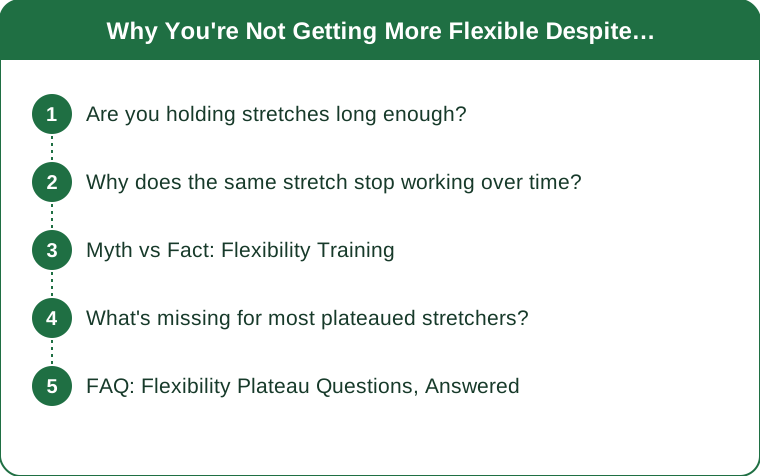
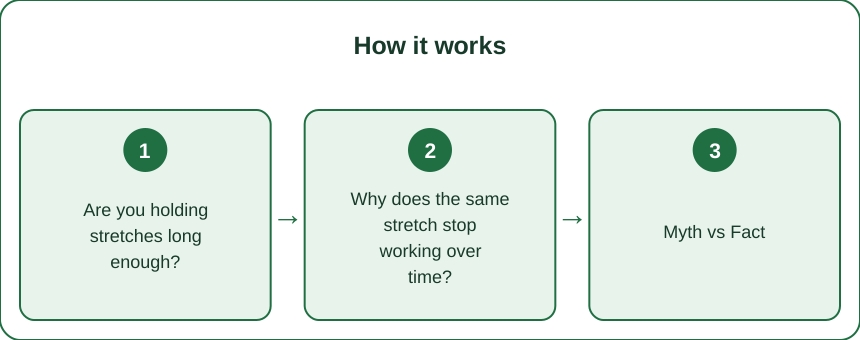
Are you holding stretches long enough?
Research on static stretching consistently points to 30-60 seconds per hold for meaningful range-of-motion gains — a 10-second stretch mostly just signals ‘not now’ to your nervous system without producing lasting change.
If your daily routine is a quick 5-second tug per muscle, you’re maintaining, not progressing. Extend key holds to a full 45 seconds and reassess after 3 weeks.
Why does the same stretch stop working over time?
Your nervous system adapts to a specific stretch position faster than the tissue itself changes — this is called neural adaptation, and it plateaus quickly if you never vary the angle or add load.
Swap in variations: a slightly rotated hip in a hamstring stretch, or a loaded version (like a Romanian deadlift pattern) that challenges the tissue differently than passive holding alone.

Myth vs Fact: Flexibility Training
Myth: Stretching more often always means faster progress. Fact: Tissue needs recovery time too — daily stretching of the same muscle at the same intensity without variation is a common plateau cause, not a virtue.
Myth: You’re either naturally flexible or you’re not. Fact: Genetics set a range, but most people training consistently with proper hold times and progressive overload see meaningful gains within 8-12 weeks, regardless of starting point.
Myth: Pain means it’s working. Fact: Sharp or pinching pain signals to back off — the productive zone is a strong stretch sensation, not pain, and pushing through pain can cause the injuries that actually set flexibility back.
What’s missing for most plateaued stretchers?
Strength at end-range. Passive flexibility (how far you can be pushed) and active flexibility (how far you can move yourself) are different, and only active flexibility carries over to real movement.
Add light loaded work at your current end-range — for hip flexibility, that might mean slow, controlled leg raises near your maximum range rather than just holding a passive split stretch. This is the step that unlocks plateaus static stretching alone can’t touch.
FAQ: Flexibility Plateau Questions, Answered
How long should I hold each stretch?
30-60 seconds per stretch for meaningful range-of-motion change, repeated 2-3 times per muscle group per session.
Is it better to stretch in the morning or evening?
Evening tends to allow deeper stretches since muscles are warmer from the day’s activity, but consistency matters more than timing — pick what you’ll actually do daily.
Can hypermobile people over-stretch?
Yes — if joints already move beyond typical range, prioritize strength and stability work over more passive stretching, and check with a professional if joints feel unstable rather than just tight.
TL;DR:
- Hold stretches 30-60 seconds, not 5-10 — short holds mostly maintain, they don’t progress
- Vary the angle and add load; the same passive stretch daily causes neural plateaus
- Add active, loaded end-range work — this is what static stretching alone misses
- Expect real gains within 8-12 weeks of consistent, varied practice
A plateau is a signal to change the input, not proof that you’ve maxed out.
Keep Reading
This article is for general informational and styling purposes only. Fit, sizing, and product availability may vary.