Already Bendy? Why Hypermobile Bodies Need Strength, Not More Stretching
Quick Answer: If you’re naturally hypermobile, more stretching isn’t the goal — control is. Replace passive stretching with strength through range: slow controlled squats, banded work, balance drills and precision-based Pilates. Train shy of your end range rather than parking in it, and keep the show-off joints micro-bent by default. Hypermobility with frequent pain, sprains or dislocations warrants a clinical assessment.
Flexibility culture has a blind spot, and it’s the naturally bendy.
If your elbows hyperextend, your thumb touches your forearm, and party tricks have always come free — more stretching is solving a problem you do not have, while skipping the one you do.
Loose joints don’t crave range. They crave control. And the training flips accordingly.

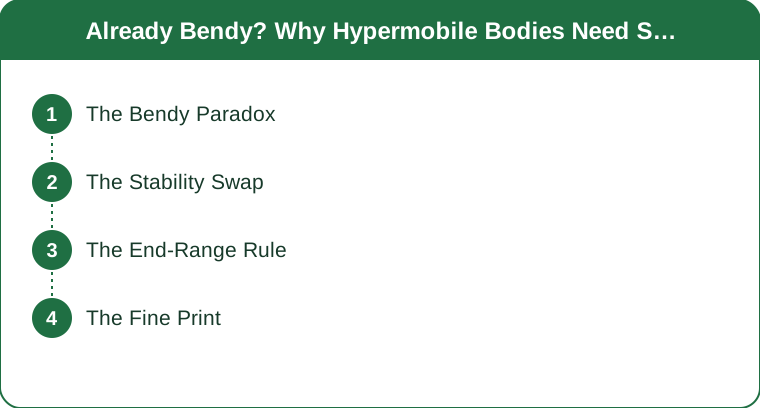
Why does stretching feel so good if I’m already flexible?
Because the sensation you’re chasing isn’t tightness — it’s usually the muscular fatigue that comes from working overtime to stabilize a joint that has too much available range.
Here’s the paradox. Hypermobile joints move past normal range easily, and range without control is exactly where the aches, clicks and rolled ankles live. The muscles around a loose joint work constantly to keep it in a safe position, and that constant low-grade effort feels like tightness.
So you stretch it. It feels great for about twenty minutes. Then it comes back, because you treated the symptom and slightly worsened the cause.
The tell: if a stretch gives relief that never lasts, and you’re already flexible, you’re almost certainly looking at a stability problem wearing a mobility costume.
What should hypermobile people do instead of stretching?
Swap passive stretching for strength through range. Same positions, but you’re producing force rather than hanging in them.
Slow controlled squats. 3 seconds down, brief pause, controlled up. 3 sets of 8. The tempo is the point — speed lets you bounce out of the bottom on connective tissue instead of muscle.
Banded work. Lateral walks, banded rows, band pull-aparts. Bands provide constant tension through the whole range, which is exactly the input a loose joint needs.
Balance and proprioception drills. Single-leg stands (eyes closed makes it real), single-leg deadlifts, step-downs. Hypermobile people frequently have less accurate joint position sense, and this trains it directly. 2 to 3 minutes daily is enough to matter.
Pilates-style precision work. Small range, high control, lots of feedback. It’s genuinely well suited here, provided the instructor understands hypermobility and doesn’t cue you into your deepest range.
Isometric holds at mid-range. Wall sits, planks, side planks, glute bridge holds. Building strength in the middle of a range, where you’re safest.
The goal, in one line: muscles that chaperone the extra range. Flexibility with a security detail.

What’s the end-range rule?
Train shy of your maximum, not at it.
Hanging out in hyperextension feels like resting. Locked knees while standing, a swaybacked passive stretch, elbows jammed straight in a plank — these positions let you stop using muscle and hand the load to ligaments and joint capsules instead. It’s comfortable precisely because the muscles have clocked off.
Over years, that’s the load pattern associated with the aches most hypermobile people are trying to stretch away.
The practical fix: micro-bend the show-off joints by default.
- Standing: soft knees, not locked.
- Planks and push-ups: a barely visible bend at the elbow.
- Overhead work: don’t jam the shoulder into its absolute end range.
- Yoga: back off about 10% from your deepest available position and hold with effort instead of sinking.
It’ll feel like you’re doing less. You’re actually doing considerably more — you’ve just moved the work from your ligaments back to your muscles, where it belongs.
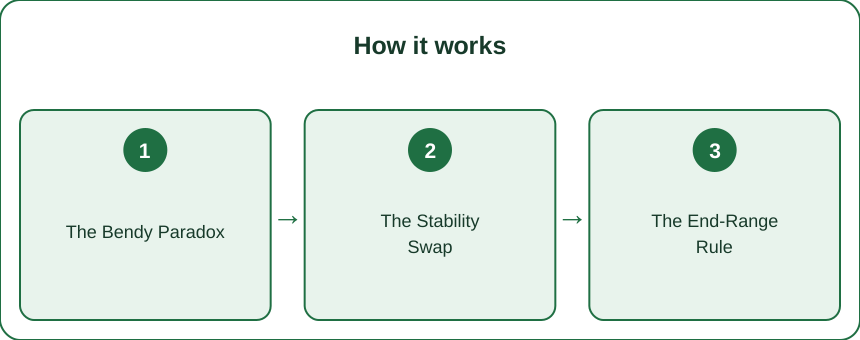
Myth vs Fact
Myth: Flexible people are less injury-prone. Fact: Excess range without control is its own risk profile — ankle sprains, subluxations and joint pain are all more common in hypermobile populations.
Myth: Hypermobile people should avoid strength training. Fact: The opposite. Strength training is the primary intervention. What needs adjusting is the technique: controlled tempo, mid-range emphasis, no locking out.
Myth: If it doesn’t hurt during the stretch, it’s fine. Fact: Hypermobile people frequently have reduced joint position awareness, which means the warning signals arrive late. That’s exactly why the end-range rule is a rule and not a feeling.
Myth: You’ll get stiff if you stop stretching. Fact: You have range to spare. Losing 5 degrees of hyperextension you never needed is not a loss, and most hypermobile people find they feel better within a few weeks.
Myth: Yoga is bad for hypermobile people. Fact: Yoga is fine — deep passive end-range yoga is the issue. Strength-focused styles, and any class where you can hold at 90% instead of sinking to 100%, work well.
What should you wear and how should you start?
Start with two things, not ten: a twice-weekly strength session built around slow controlled compound movements, and two minutes of daily balance work. That’s it for the first month. Adding a complicated program is how this becomes another thing you don’t do.
For the sessions themselves, anything that lets you see your alignment helps — hypermobile bodies benefit unusually much from watching their own joint positions. Fitted gear beats baggy for exactly that reason, which is why high waist compression leggings are a practical pick here rather than a style one: you can actually see whether that knee is tracking or drifting inward on a slow squat.
When should you see a professional?
Everyday bendiness plus persistent symptoms moves this from training advice to a clinical conversation. Book an assessment if you have:
- Frequent joint pain, especially in multiple joints
- Repeated sprains, subluxations or dislocations
- Widespread fatigue alongside joint symptoms
- Digestive issues, dizziness on standing, or unusual bruising alongside hypermobility
- Symptoms that are worsening rather than stable
Hypermobility spectrum disorders and hypermobile Ehlers-Danlos syndrome are real diagnoses with real management pathways, and a physiotherapist who works with hypermobile patients is worth seeking out specifically. For the simply-stretchy with no symptoms: strength is your stretching. Enjoy the plot twist.
FAQ
Should hypermobile people stretch at all?
Some, in specific cases — a genuinely tight area can coexist with general hypermobility, often calves or hip flexors. The rule is targeted stretching where you’re actually tight, never global stretching because it feels good.
How do I know if I’m hypermobile?
The Beighton score is the common screening tool — it checks elbow and knee hyperextension, thumb-to-forearm, little-finger extension past 90 degrees, and palms-to-floor. A clinician can score it properly in about two minutes.
Can hypermobility be improved with training?
The joint laxity itself is largely structural and doesn’t change much. What changes substantially is control — strength, proprioception and stability all improve with training, and that’s what determines symptoms.
TL;DR:
- Loose joints need control, not more range. Stretching relief that never lasts is the tell.
- Swap passive stretching for strength through range: slow squats, bands, balance work, Pilates precision.
- Train shy of end range. Micro-bend knees and elbows by default — locked joints hand the load to ligaments.
- Start small: two strength sessions weekly plus two minutes of daily balance work.
- Frequent pain, sprains or dislocations = get assessed. Hypermobility spectrum disorders are real.
Keep Reading
This article is for general informational and styling purposes only. Fit, sizing, and product availability may vary.