Why Your Flexibility Hasn't Improved Despite Stretching Regularly for Months
Quick Answer: Stretching consistently for months without gaining range of motion usually means passive stretching alone has hit its ceiling — you’ve adapted to tolerate the sensation rather than actually lengthened tissue further, and your nervous system is protectively restricting range because you lack strength at that end range. The fix is adding active, loaded stretching and strength work through your newly accessible range, not just stretching more of the same.
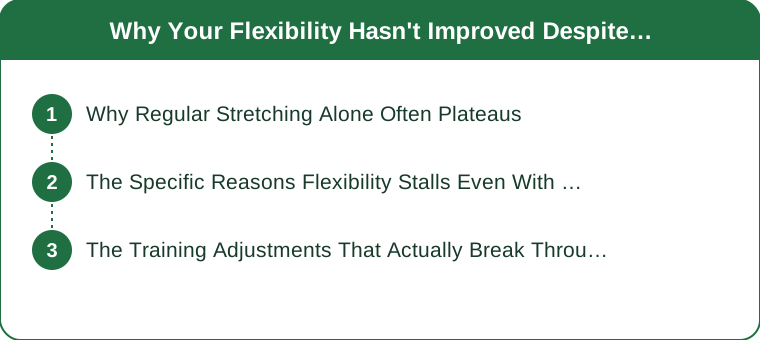
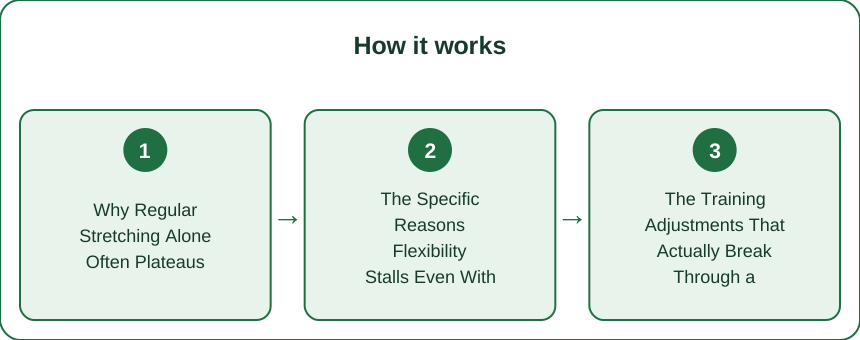
Stretching consistently several times a week for months and seeing essentially no further improvement in actual range of motion is a specific and common frustration that plain “stretch more” advice doesn’t really address, since the person asking that question is often already doing exactly that. Here’s why regular stretching alone often plateaus, the specific reasons flexibility stalls even with real consistency, and the training adjustments that actually break through it.

Why Does Regular Stretching Alone Plateau?
The core limitation is this: passive stretching mostly trains your tolerance to the stretch sensation rather than meaningfully lengthening tissue beyond an initial adaptation window. A real chunk of your early flexibility gains came from getting more comfortable with the sensation of stretching, not from tissue actually stretching further — and that kind of tolerance adaptation has a natural ceiling that continued passive stretching alone doesn’t push past.
On top of that, your nervous system actively guards your range. This works similarly to how tight hips get protectively restricted, except it applies broadly to flexibility plateaus in general, not just one joint. Specifically, a lack of strength at the outer edge of a given range triggers your nervous system to restrict access to that range — regardless of whether the tissue itself could physically stretch further. There’s also a duration problem hiding in plain sight: frequent short stretch holds at a comfortable intensity can feel like consistent effort while never actually reaching the specific duration and intensity threshold that produces further adaptation. And finally, some of the plateau is just real anatomy — individual variation in joint and bone structure means part of anyone’s plateau reflects a genuine ceiling, not a fixable training gap.

What Are the Specific, Hidden Reasons Flexibility Stalls Even With Real Consistency?
A few gaps commonly hide behind an apparently consistent routine:
- The same stimulus, repeated forever, stops being novel. An unchanging routine stops providing a novel enough stimulus once your body has fully adapted to it — a familiar plateau pattern across nearly every kind of training, not just stretching.
- No strength-through-range signal. Passive stretching alone never gives your nervous system the active “you’re strong and stable here” signal that would let it release additional range. Without that signal, the range simply stays locked.
- Stretch holds that are shorter than they feel. The actual held duration of any individual stretch often falls well short of what research associates with continued adaptation, even while your overall weekly session count looks perfectly consistent.
- Generic stretching instead of targeted stretching. Stretching broadly rather than identifying and specifically targeting whichever structure is the true limiting factor in a compound movement wastes effort on tissue that was never the actual bottleneck.
- Unaccounted-for recovery and stress. Stress, poor sleep, and inconsistent practice affect your nervous system’s readiness to release range — none of which shows up in a simple count of how many times a week you stretched.
What Actually Breaks Through a Flexibility Plateau?
A handful of specific adjustments move the needle where more passive stretching doesn’t:
- Add active, loaded stretching, not just passive holds. Moving into and holding a stretched position using your own muscle strength provides exactly the nervous-system stability signal that passive stretching alone can’t.
- Actually extend your held-stretch duration to match the thresholds research associates with continued adaptation, rather than assuming your current practice is already there.
- Identify and target the true limiting structure in whatever compound movement you’re working toward, instead of stretching broadly and generically.
- Strengthen through the newly accessible range immediately after stretching. This helps convert a temporary post-stretch gain into a lasting one, rather than losing it by your next session.
- Address recovery, stress, and sleep alongside the stretching itself. Your nervous system’s readiness to release range is affected by all of these — treating flexibility as a purely mechanical training question misses a legitimate part of the picture.
Myth vs. Fact: Flexibility Plateaus
- Myth: If stretching stopped working, you just need to stretch more often. Fact: More frequency without more duration, targeting, or active strength work usually just repeats the same plateaued stimulus.
- Myth: A flexibility plateau means your body has hit its true anatomical limit. Fact: Some of it is anatomical, but a meaningful portion is nervous-system guarding tied to a strength deficit — which active, loaded stretching can address.
- Myth: Passive stretching and active stretching produce the same result over time. Fact: Only active, loaded stretching gives the nervous system the stability signal needed to release further range; passive holds alone don’t.
- Myth: Stress and sleep are unrelated to how flexible you are. Fact: Both affect your nervous system’s readiness to release range, making them a legitimate part of any flexibility plan, not a separate concern.
Flexibility Plateau FAQ
How long should I actually hold a stretch to see continued improvement?
Longer than most people assume — research-associated thresholds for continued adaptation tend to run longer than the short, comfortable holds most people default to. Extending your actual hold time, not just how often you stretch, is one of the more reliable fixes.
What’s the difference between passive and active stretching?
Passive stretching means easing into a position and holding it with external support (a wall, a strap, gravity). Active stretching means moving into and holding that same position using your own muscle strength — which is what signals to your nervous system that the range is safe to keep.
Do I need to stretch every muscle group to break a plateau, or just the tight ones?
Just the ones that are the actual limiting factor in your target movement. Generic, broad stretching wastes effort on tissue that isn’t the real bottleneck — identifying the specific structure that’s actually restricting you is more effective than stretching everything equally.
Bottom Line
A flexibility plateau despite months of consistent stretching often reflects real physiological limits of passive stretching alone — a meaningful portion of early gains come from tolerance to the sensation rather than tissue lengthening, and your nervous system protectively restricts range when strength is lacking at that outer edge, independent of whether tissue could stretch further. Break through it by adding active, loaded stretching, actually extending held-stretch duration, targeting the true limiting structure, strengthening through the newly accessible range right after stretching, and treating recovery and stress as part of the plan.
TL;DR:
- Passive stretching alone hits a real ceiling — tolerance adaptation, not tissue length, explains much of the plateau
- Your nervous system restricts range when you lack strength at that end range, regardless of tissue flexibility
- Short stretch holds and generic, untargeted stretching commonly hide behind an apparently consistent routine
- Active, loaded stretching plus strength work through the new range is what actually breaks the plateau
- Sleep, stress, and recovery are a legitimate part of a flexibility plan, not a separate issue
Keep Reading
This article is for general informational and styling purposes only. Fit, sizing, and product availability may vary.